
Article: What exactly do compression socks do?
What exactly do compression socks do?
The short answer
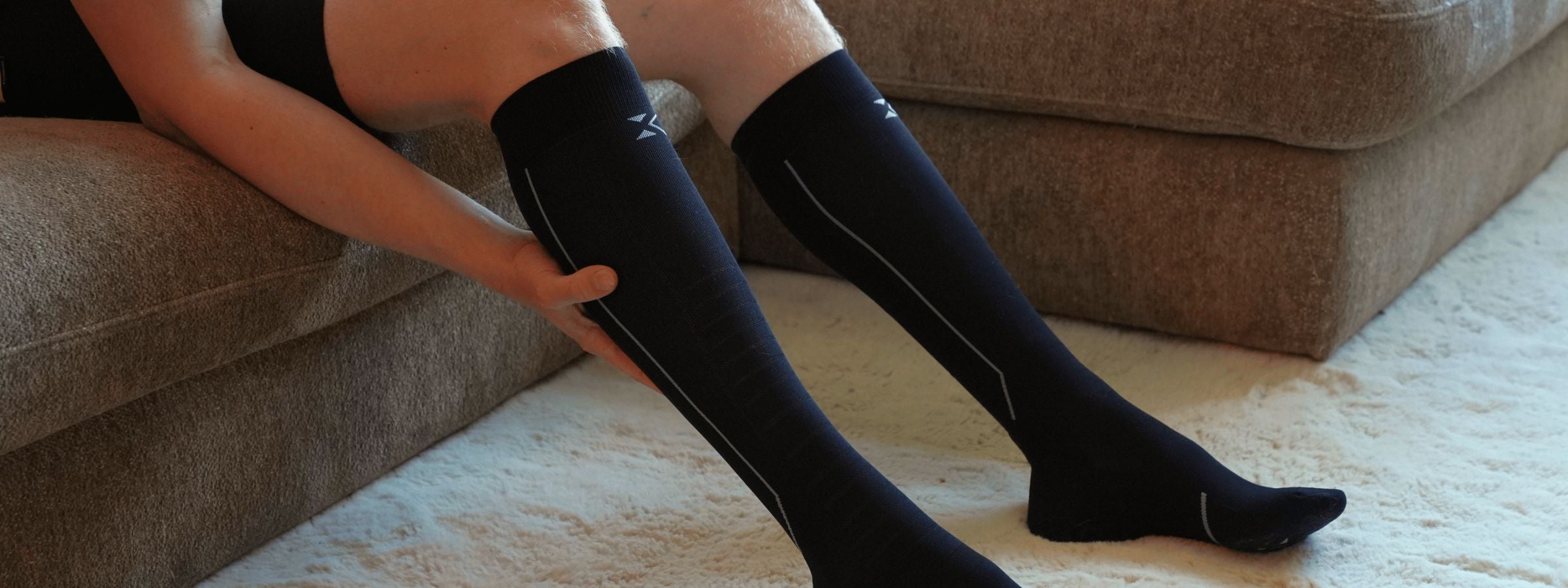
A compression sock compresses your leg in a controlled manner, with most pressure around the ankle gradually decreasing towards the calf. This has two demonstrable effects: it supports blood circulation in your legs and it reduces muscle and tissue vibration during movement.
Or as Maarten, enthusiastic athlete and co-founder of KINEX, summarizes: compression socks help you exercise longer, stronger, and safer, so you stay on your feet and your sports rhythm remains protected.
The biggest misconception
Before we delve into what compression socks do, let's first address what they don't do. Justin, physical therapist and co-founder of KINEX, knows the most common misconception: “People think they make you faster, improve your VO2max, or even cure injuries. It's more nuanced than that. You shouldn't see it as a miracle cure, but as support that you can put to good use during exertion.”
Science confirms this. No recent meta-analysis finds that compression socks make you faster. What they do, however, is in a different realm. Do you want to know if compression makes sense during running? Then also read our article compression socks for running: sense or nonsense?
What compression does to your circulation
When you stand, blood pools in your lower legs. Your calf muscles act as a pump that pushes that blood back up. Compression supports this process: it narrows the veins slightly, speeds up blood flow in them, and limits the accumulation of blood and fluid.
How significant is this effect? A 2023 meta-analysis by O'Riordan and colleagues in Sports Medicine aggregated 22 studies and found a small to moderate positive effect on blood flow in the legs. The effect was most evident during the recovery period after exertion and during activity, and less pronounced at rest. This pressure gradient from ankle to calf is called gradual compression. You can read exactly how this works in gradual compression explained.
Important nuance: increased flow velocity in your veins does not mean that every muscle automatically receives more blood or oxygen. In some studies, the local blood flow to a specific muscle actually decreased slightly. The system as a whole works better, but it's not an oxygen turbo for your muscles.
What compression does to muscle vibrations
This is the most consistently demonstrated effect. With every footstrike during running, your soft tissue—skin, fat, connective tissue, and muscles—vibrates shortly afterward. Compression holds that tissue more compactly together and reduces that vibration.
Maarten noticed this himself while training for long distances: “I mainly felt more stability during exercise, which gives you a safer and stronger feeling. For long distances, you notice that the impact and muscle vibrations on your legs are noticeably less.”
Science supports this experience. The 2025 meta-analysis by Wang and colleagues in the Journal of Sport and Health Science aggregated 51 studies and found a clear reduction in tissue vibration. Research by Broatch and colleagues (2020) confirmed this: less tissue movement and less electrical muscle activity during running.
Does that help prevent injuries?
A logical follow-up question. The honest answer is nuanced, but certainly not negative. Compression socks are no guarantee against injuries, but there are indications that they can contribute to preventing recurring complaints. Research among more than 500 athletes (Franke, Backx & Huisstede, 2021) showed that runners who consistently wore compression suffered less often from recurring lower leg injuries.
And because compression demonstrably reduces muscle vibrations, and those vibrations play a role in muscle and tendon overuse, there is a logical mechanism that supports this. There is no hard evidence yet that compression prevents injuries, but as support in protecting your training rhythm, it is well defensible.
The difference from a regular tight sock
This is where it gets interesting. A regular sports sock can also be tight, but without measurement, you don't know how much pressure it provides, where the pressure is highest, whether the pressure gradually decreases from ankle to calf, and whether each sock in each size provides the same pressure.
Maarten describes the difference as follows: "The biggest difference with sports socks is that compression socks really contribute to longer, stronger, and safer exercise. They reduce muscle vibrations, offer more stability, and can support your recovery after heavy exertion. This is because KINEX compression socks offer gradual compression of 23-32 mmHg, and regular sports socks do not have that measured pressure distribution."
Research by Brophy-Williams and colleagues showed that the actual pressure of compression clothing varies greatly with the type, size, and your body posture. A sock can therefore feel tight without providing a controlled, gradual compression profile. This is precisely why KINEX measures and controls compression with Swisslastic MST technology: so you can be sure that the pressure stated on the package is also the pressure your leg receives. Curious which compression class suits you? Read the difference between class 1 and class 2.
What compression socks do and don't do
Scientifically quite certain:
- Support blood flow in the legs and limit blood pooling
- Reduce muscle and tissue vibrations during movement
- Reduce swelling when sitting or standing for long periods
- Often reduce perceived muscle soreness after exertion
Plausible, but not firmly proven:
- Contribute to preventing recurring complaints
- Support strength recovery after heavy exertion
Not demonstrated:
- Becoming faster or achieving better race times
- Lower heart rate or oxygen uptake during sport
- Faster lactate clearance
The conclusion
Compression socks do something real: they support your circulation and keep your muscles more stable. Not a miracle cure, but real support. Those who buy them for the right reason—comfort and stability during and after exertion—get their money's worth.
Perseverance wins. Good compression helps you continue comfortably.
Sources
O'Riordan et al. (2023), Sports Medicine · Wang et al. (2025), Journal of Sport and Health Science · Broatch et al. (2020), Medicine & Science in Sports & Exercise · Franke, Backx & Huisstede (2021), BMC Sports Science, Medicine and Rehabilitation · Brophy-Williams et al. (2015), Journal of Sports Sciences · Weakley et al. (2022), Sports Medicine