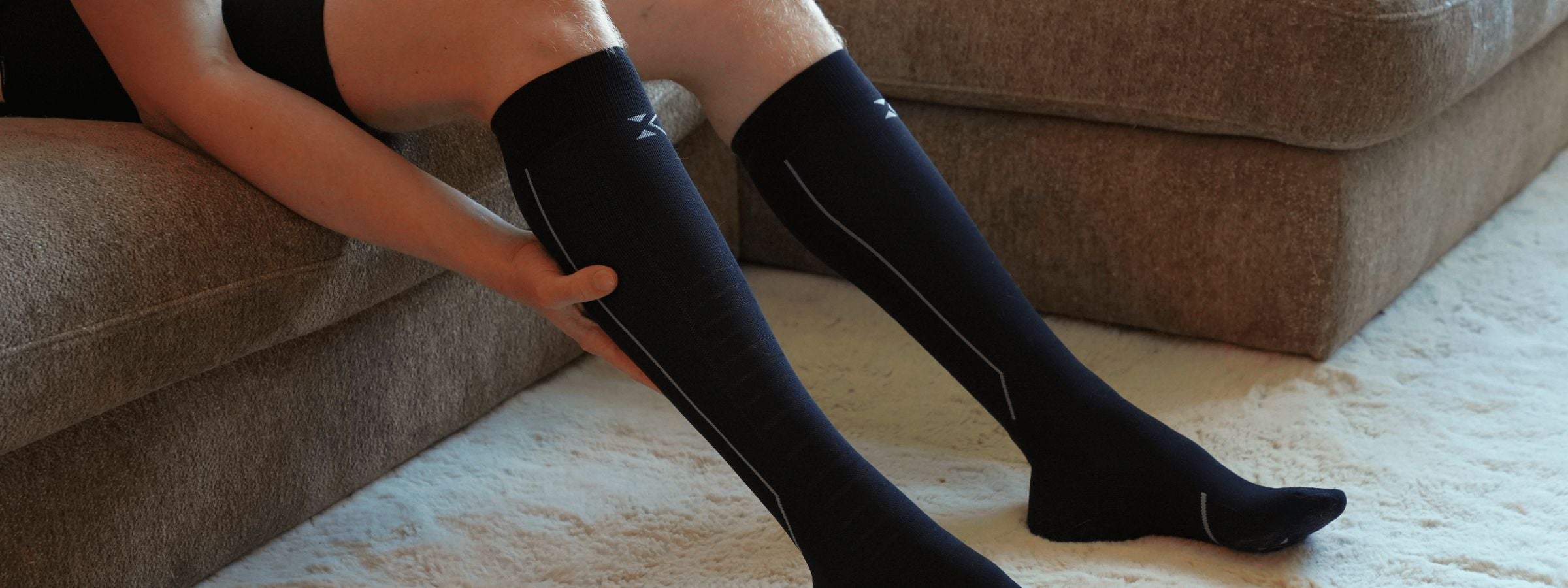


Muscle recovery after a marathon or long endurance training
The short answer
A marathon doesn't cause a single type of fatigue with a fixed recovery time. Muscle soreness, strength, energy stores, and inflammation levels all recover at their own pace. The best-supported basis for recovery is simple: enough carbohydrates, protein, fluids, and salt, sufficient sleep, and gradually getting back into motion.
Compression is a comfortable addition to this. It can positively influence muscle soreness and the feeling of recovery, but it doesn't demonstrably repair your muscle tissue faster.
What happens in the first few days
During a marathon, your quadriceps and calves, in particular, perform thousands of braking, eccentric contractions. This causes temporary loss of strength, stiffness, some swelling, and the release of damage markers such as creatine kinase. In marathon research, this marker remained elevated for about 96 hours and normalized around 144 hours (Bernat-Adell et al., 2021).
Important nuance: the inflammatory response associated with this is not purely harmful. A controlled inflammation is part of the clean-up and recovery process. A lower inflammation value is therefore not automatically better recovery.
Your glycogen stores, the fuel in your muscles, can be almost depleted after a marathon. Remarkably: even with ample carbohydrates, these stores were still about 30 percent lower than before the marathon after two days, and only recovered after a week (Asp, Rohde & Richter, 1997).
The basis of recovery: nutrition and sleep
Carbohydrates provide the clearest direct effect on replenishing your glycogen. Protein supports tissue repair but does not replace carbohydrates. Fluids and sodium restore your fluid balance.
Maarten, co-founder of KINEX, addresses this immediately: “Immediately after a long effort, I first cool down gently and try to eat and drink as soon as possible. I especially focus on carbohydrates, proteins, fluids, and salt. After that, I often put on compression socks, especially if I still have to travel or sit a lot.”
Justin, physiotherapist and co-founder of KINEX, names the most underestimated recovery strategy: “Enough food and sleep. That sounds simple, but in practice, it often goes wrong. Athletes look for ice baths, massage guns, and other recovery methods, while they eat too little or only sleep six hours after a tough workout.”
What does compression do after a marathon?
The results are most positive for perceived muscle soreness and recovery. Hill et al. (2014) had runners wear compression for 72 hours after a marathon: better perceived recovery and less muscle soreness, but no improvement in muscle strength, creatine kinase, or inflammatory markers.
A meta-analysis of 19 studies found no convincing improvement in muscle strength recovery due to compression (Négyesi et al., 2022). Supporting venous blood flow is possible; demonstrably faster repair of muscle tissue is not.
Maarten uses them specifically: “My toes must stay warm, I don't want to feel tingling, and the cuff should not press painfully into my skin. If all that is right, I notice that my lower legs feel less heavy and swollen.” More about compression and muscle soreness can be read in do compression socks help against muscle soreness?
Active recovery or complete rest?
Justin: “Active recovery doesn't mean you have to start training again the next day. It involves light movement that causes hardly any extra strain, such as walking, gentle cycling, or some flexible mobility exercises. In case of sharp pain, significant swelling, or an abnormal gait, rest is more sensible.”
Maarten: “For me, light movement usually works better than sitting still all day. But I do try to leave my sports ego at home. A recovery walk doesn't have to become a disguised workout.”
How long does full recovery take?
Around six to eight days, many values approach their baseline. 72 hours is too short as a universal term; about a week is more realistic for broad recovery. Adjust the restart based on muscle soreness, normal movement, sleep, and motivation.
The conclusion
Good marathon recovery revolves around the basics: eating, drinking, sleeping, and gradually building up. Compression is a comfortable addition with the most value for muscle soreness and the feeling of recovery. Don't expect accelerated repair of your muscles, but rather legs that feel somewhat fresher in the days afterward.
Perseverance pays off. Recovery is where the next performance begins.
Medical disclaimer
This article provides general information and is not personal medical advice. Persistent sharp pain, clear swelling, loss of sensation, shortness of breath, dark urine, or severe complaints after a marathon require medical evaluation.
Sources
Bernat-Adell et al. (2021), Journal of Strength and Conditioning Research · Asp, Rohde & Richter (1997), Journal of Applied Physiology · Craven et al. (2021), Sports Medicine Open · Walsh et al. (2021), British Journal of Sports Medicine · Dupuy et al. (2018), Frontiers in Physiology · Hill et al. (2014), Journal of Strength and Conditioning Research · Négyesi et al. (2022), Sports Medicine · O'Riordan et al. (2023), Sports Medicine · Martínez-Navarro et al. (2021), European Journal of Sport Science · Takayama et al. (2017)