

Compression socks in summer: can you wear them in hot weather?
At thirty degrees Celsius, knee-high compression socks don't immediately sound like the most logical choice. However, with a breathable, well-fitting sock, it often turns out to be fine in practice, and compression can be particularly useful in warm weather. In this article, you'll read about what heat does to your legs, what research says about heat and performance, and how to choose a sock that remains comfortable in the summer.
Why heat increases swelling
In warm weather, your skin vessels dilate to dissipate heat, causing more blood to flow into the peripheral vascular bed. In a standing or sitting position, gravity then promotes venous pooling in the feet and lower legs. The result is well-known: thicker ankles and heavier legs on warm days. A large study in people with venous complaints showed that more than half found swelling worsened in warmer weather (Santa Cruz et al., 2023, Journal of Vascular Surgery: Venous and Lymphatic Disorders). Graduated compression, however, counteracts this venous edema and continues to function mechanically in the heat.
Does a sock make you warmer?
A compression sock covers the skin and usually increases the local skin temperature beneath the fabric. This sounds unfavorable, but a higher skin temperature is different from a higher core temperature. Research on leg compression during exercise in the heat generally shows no increase in core temperature and no deterioration in performance. Goh et al. (2011, European Journal of Applied Physiology) had runners run to exhaustion at 32 degrees Celsius and found no difference in time or rectal temperature between those with and without compression. Interestingly, laboratory research showed that graduated stockings actually enhanced skin vasodilation without suppressing sweating (Fujii et al., 2017, Physiological Reports).
What compression does not do in summer
Let's be honest here. A compression sock is not a coolant. There is no convincing evidence that compression lowers your body temperature or that special moisture-wicking yarns make you cooler. Studies with tight upper body compression in extreme heat even showed a slightly higher core temperature and heart rate, although this applies to a much larger covered skin surface than a knee-high sock. The honest message: a sock can be worn perfectly fine in summer and can help against swelling, but it does not cool you down and does not demonstrably improve your performance in the heat.
How Maarten does it himself
Maarten, an avid athlete and co-founder of KINEX, also wears them in the summer but pays more conscious attention to the timing: "During a warm training session, I mainly want a sock that doesn't stick, chafe, or fill up with sweat. After a long endurance run, I notice that I still find the support pleasant, especially when my calves have been working hard." He puts the mandatory nature into perspective: "I wouldn't say you should wear them all day at all costs. Use them smartly around your training or recovery time. Just like with your pace in the heat: don't force it, but keep thinking."
How do you choose a summer sock?
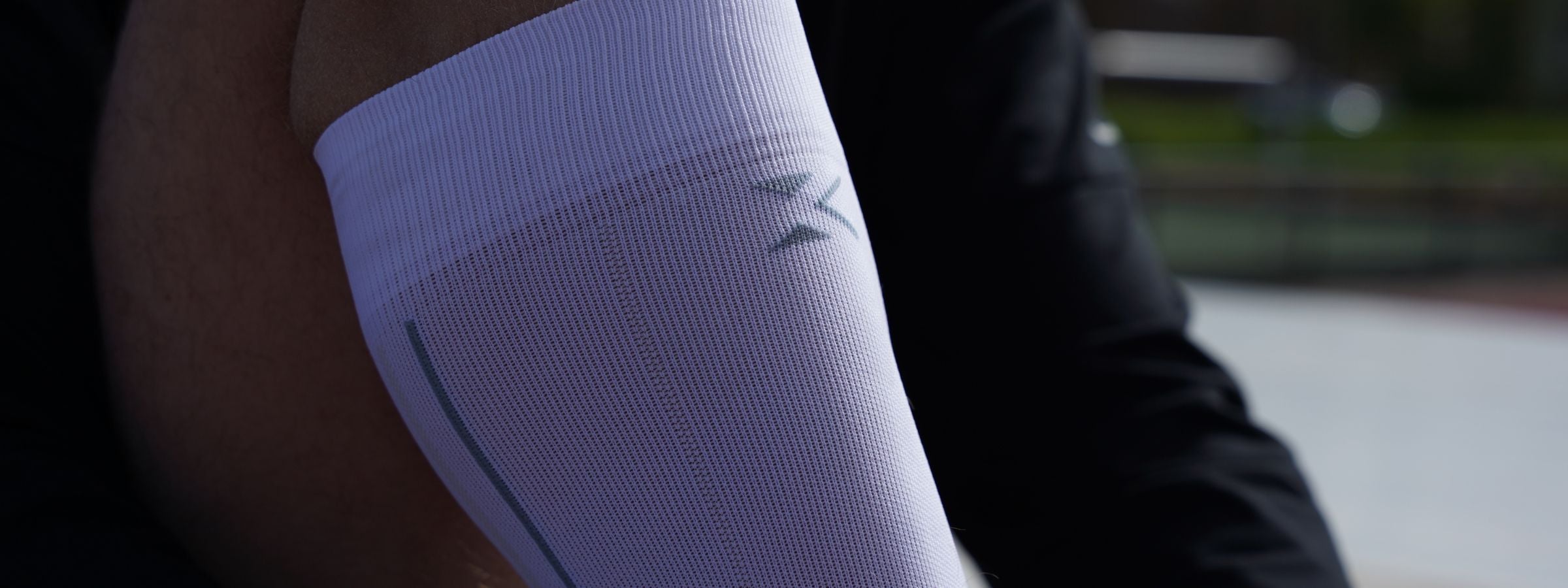
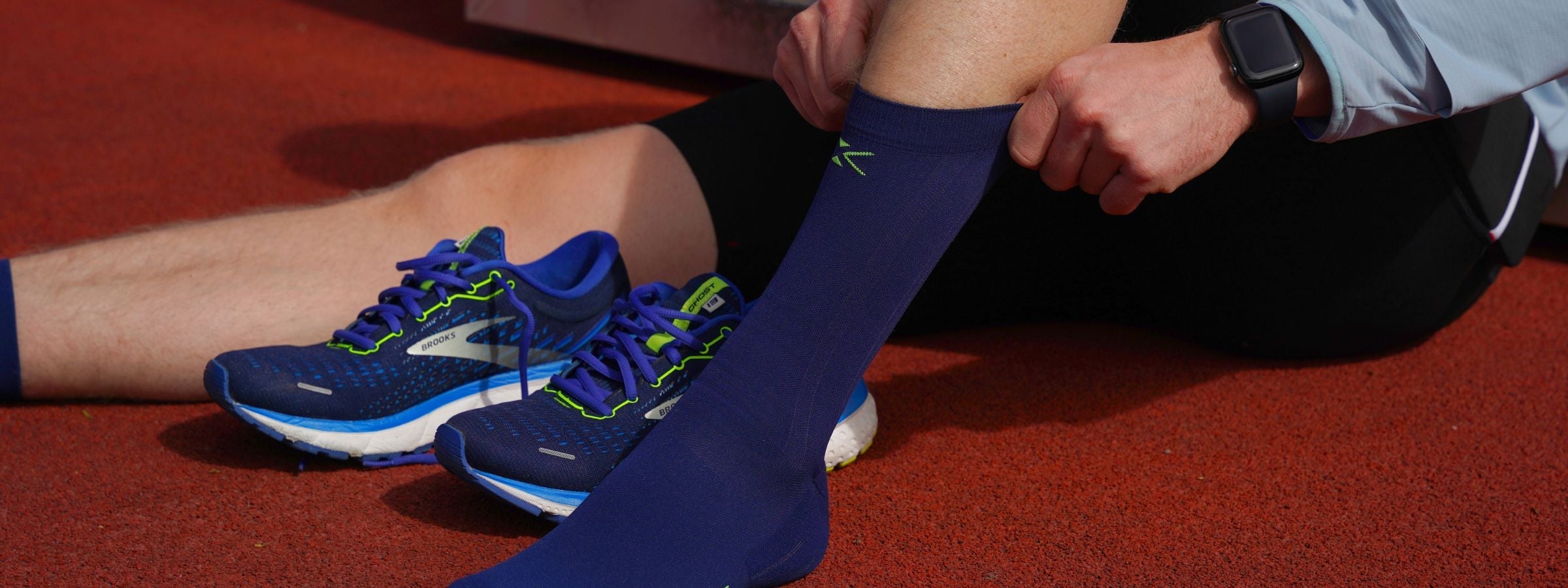
In warm weather, choose a light, thin, and quick-drying model with demonstrably stable compression. Pay attention to ventilation zones and a low material thickness, but be critical of unproven cooling claims. A good fit is especially important in summer: your leg expands slightly in the heat, and a poorly fitting sock can then feel tighter or constrict. Pull the sock on smoothly, without wrinkles or a folded cuff. And in high humidity: expect little from a moisture-wicking fabric, because evaporation is simply limited then. You can find out how to determine the correct size in our size guide.
The conclusion
You can wear compression socks in the summer as long as they fit well and remain comfortable. Heat actually increases the tendency to swell, and graduated compression can provide support in such cases. The sock itself is not a coolant and makes the skin locally slightly warmer, but research usually shows no relevant increase in core temperature. Choose light and breathable, test during training, and always prioritize heat acclimatization, pace, and hydration.
Perseverance pays off. Even when the mercury rises.
Sources
Santa Cruz et al. (2023), Journal of Vascular Surgery: Venous and Lymphatic Disorders · Fujii et al. (2017), Physiological Reports · Goh et al. (2011), European Journal of Applied Physiology · Priego Quesada et al. (2015), Journal of Thermal Biology · Weakley et al. (2022), Sports Medicine