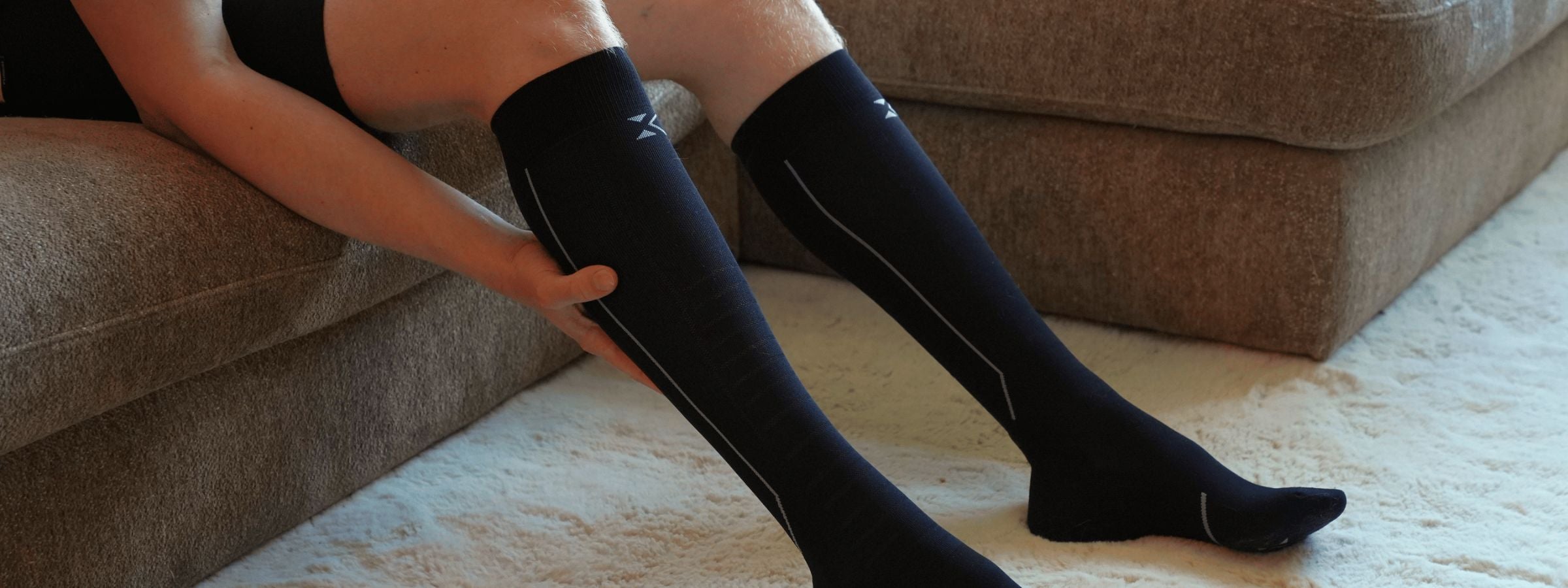


Compression socks for flying: do they help against swollen legs?
Around holidays and long flights, KINEX regularly receives questions about whether compression socks help against swollen legs on a plane. Most people are not directly concerned with thrombosis, but rather with heavy, swollen, and tired legs after hours of sitting still. In this article, you can read what compression demonstrably does during a flight, what the evidence around thrombosis does and does not say, and what else you can do yourself.
What does compression do during a flight?
During a flight, you move little and your calf muscle pump is barely active. Compression can then provide support for the drainage of blood and fluid from the lower legs, making your legs feel less heavy after landing. This effect is well-substantiated. In a randomized study, 34 travelers wore a stocking on one leg and not on the other during a three-hour flight; the difference in swelling was a median of 5 millimeters around the ankle and calf, in favor of compression (Olsen et al., 2019, European Journal of Internal Medicine). So, even after a relatively short flight, there is a measurable effect on swelling.
What about the risk of thrombosis?
Nuance is important here. A Cochrane review of twelve studies with almost 3,000 travelers found that graduated compression stockings significantly reduced the number of asymptomatic, ultrasound-detected cases of thrombosis: 3 cases with stockings versus 47 without, on flights longer than five hours (Clarke et al., 2021, Cochrane Database of Systematic Reviews). What does not follow from this is important: in these studies, no symptomatic thrombosis, pulmonary embolism, or death occurred. We therefore do not claim that a sock prevents dangerous blood clots or pulmonary embolism. For healthy travelers, the absolute risk is small, and guidelines do not routinely advise compression purely as thrombosis prophylaxis.
Where is the line between sports and medical?
KINEX remains vigilant about this: "We consciously remain on the border between sports and medical advice. Compression socks are not a substitute for exercise, sufficient hydration, or medical advice in case of an increased risk of thrombosis." If you have an increased risk, for example due to a previous thrombosis, recent surgery, pregnancy, or active cancer, personal medical advice is advisable. For a clearly increased risk, guidelines mention a well-fitting knee-high stocking of 15 to 30 mmHg, sometimes combined with medication, but this should be handled by a doctor.
What else can you do yourself?
A sock is only part of the story. During a long flight, occasionally walk around the aisle and work your calves with some ankle pumps and calf contractions. This activates the muscle pump and is physiologically logical. Drinking enough is wise, although it is not in itself a proven thrombosis prevention. See it as active recovery at ten kilometers altitude. If you want to know how long you can comfortably wear a stocking, read how long and how often to wear compression socks.
The conclusion
Compression socks can demonstrably reduce leg swelling during a flight, and on long flights, they reduce the number of asymptomatic thromboses found in research. It has not been proven that they prevent symptomatic thrombosis or pulmonary embolism. For healthy travelers, compression is mainly a comfortable choice against swollen and heavy legs. If you have an increased risk: get advice, and see the sock as a supplement, not as a replacement for medical advice.
Perseverance pays off. Even at ten kilometers altitude.
Medical disclaimer
This article is general information and not personal medical advice. In case of an increased risk of thrombosis or symptoms such as sudden unilateral leg swelling, shortness of breath, or chest pain, a medical assessment should first take place. Compression socks do not replace prescribed anticoagulation.
Sources
Clarke et al. (2021), Cochrane Database of Systematic Reviews · Olsen et al. (2019), European Journal of Internal Medicine · McKerrow Johnson et al. (2022), Wilderness & Environmental Medicine · Kahn et al. (2012), Chest · Rabe et al. (2020), Phlebology