

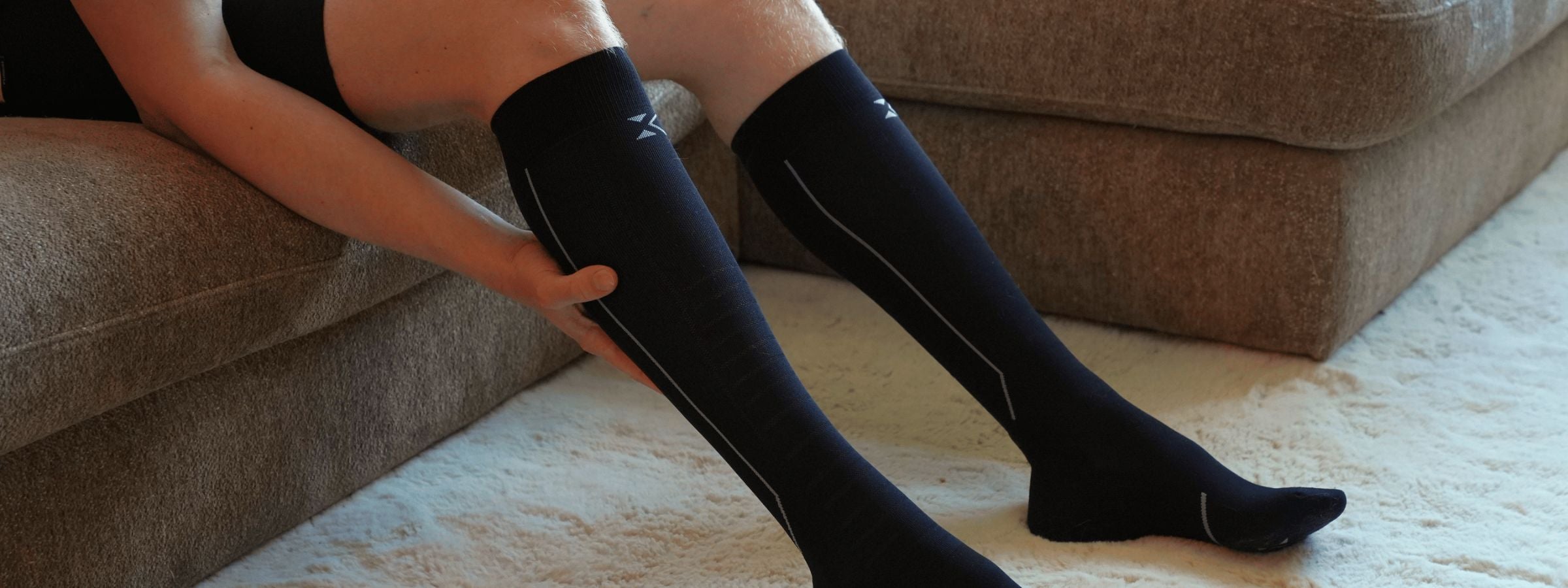
Compression Socks for Standing Work: for those who stay on their feet
Technically, someone who stands all day is on their feet, but the calf muscle pump works much less hard than when walking. It is precisely this pump that helps to move blood and fluid from the lower legs back upwards. If you stand in one place for a long time, fluid can accumulate around the ankles, leading to the familiar heavy, swollen feeling at the end of the day. In this article, you will read what compression does to help with this, and what you can realistically expect from it.
What does compression do when standing for long periods?
Graduated compression applies controlled pressure from the outside, highest around the ankle and gradually decreasing upwards. This supports the system your body already has: veins are supported, venous return improves, and less fluid accumulates in the tissue. You don't need to think of extremely tight socks. Good compression feels firm and supportive, not as if your legs are in a vice. Justin, a physiotherapist and co-founder of KINEX, explains it this way: “When you stand all day, your calf muscle pump works less hard than when you walk. It is precisely this pump that helps to move blood and fluid from the lower legs back upwards. Compression supports that system from the outside.”
What the research shows
The strongest and most consistent effect is a reduction in work-related swelling. Garcia and colleagues (2023, Human Factors) followed forty security guards during a twelve-hour standing shift. In the group wearing regular socks, clear calf fatigue, swelling, and discomfort occurred; these changes were absent in both compression groups. Notably: 15-20 mmHg and 20-30 mmHg performed similarly, so more pressure was not better here. Among hairdressers, Agle and colleagues (2020, Jornal Vascular Brasileiro) found the same pattern: without stockings, ankle circumference increased from an average of 21.1 to 22.1 cm over the workday, while with 18-20 mmHg compression, it remained at 21.2 cm. Pain and fatigue also decreased.
Which pressure is logical?
For a healthy employee with mild to moderate complaints of heavy legs or slight end-of-day swelling, a knee-high stocking around 15 to 21 mmHg is a defensible starting point: noticeably supportive, comfortable, and sustainable over a long day. For clear, recurrent swelling, higher pressure may be more effective, but this is not always better in every study and can be less comfortable. In Garcia's study, the heavier class was not demonstrably better than the lighter one. Comfort and wearability are therefore not secondary: a sock that you take off after an hour does nothing. If you are unsure about the pressure class, read the difference between Class 1 and Class 2 compression socks.
What compression does not do
Let's be honest here. There is no convincing evidence that daily wearing of compression socks prevents the development of varicose veins or chronic venous disease in healthy employees. However, prolonged standing is a risk factor for venous complaints, and compression reduces the short-term mechanisms involved, such as venous pooling and edema. This makes a protective effect biologically plausible, but it has not been proven. Therefore, we do not claim that a sock prevents varicose veins. What we can say is that compression can help limit daily venous strain and work-related swelling.
Practical advice for standing work
Put on the sock in the morning, before swelling has built up, and wear it during the hours you are standing. Choose your size based on ankle and calf circumference, not just shoe size; you can find out how to measure that in our size guide. And remember that compression does not replace movement: short walking breaks, brief moments of tiptoeing, and changing positions are still necessary. If you want to understand exactly what the sock does, read what compression socks do exactly.
The conclusion
For those who stand for long periods, compression can demonstrably reduce swelling and the heavy feeling at the end of the day. A pressure around 15 to 21 mmHg is a logical first choice for most healthy employees. Expect support and fresher legs, not proven protection against varicose veins.
Perseverance pays off. Also for those who stay on their feet all day.
Sources
Garcia et al. (2023), Human Factors · Hecko et al. (2022), Clinical Hemorheology and Microcirculation · Agle et al. (2020), Jornal Vascular Brasileiro · Amsler & Blättler (2008), European Journal of Vascular and Endovascular Surgery · Rabe et al. (2020), Phlebology