
Compression socks for walkers and hikers
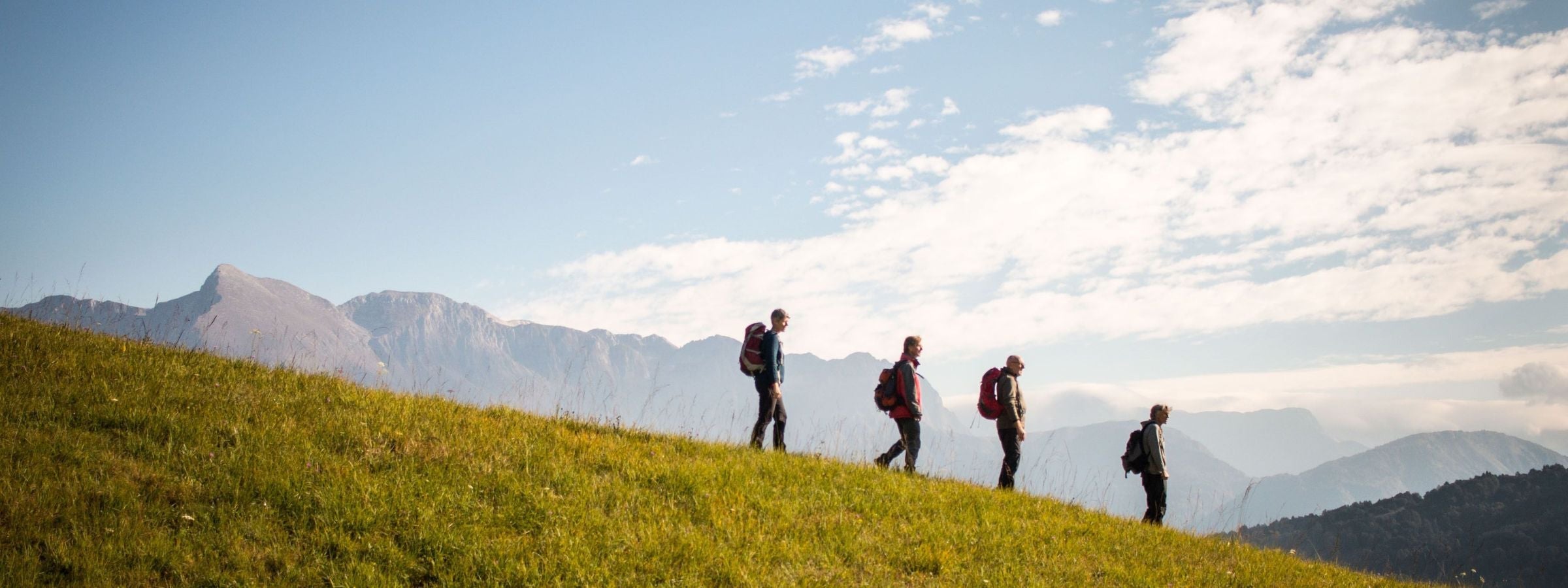
A long walk, a multi-day trek, or a challenging hike with a heavy backpack: your legs work for hours at a low, constant intensity. It's precisely this kind of strain that can lead to fluid accumulation in your lower legs, making your calves feel heavy at the end of the day. In this article, you'll learn what compression does and does not do during hiking, and what you can honestly expect from it. No empty promises.
What does compression do during hiking?
The best-substantiated benefit for hikers is a reduction in lower leg swelling. Gianesini and colleagues (2019, Journal of Vascular Surgery: Venous and Lymphatic Disorders) had twenty healthy adults walk for thirty minutes with knee-high graduated stockings of 20 to 30 mmHg. The measured lower leg volume decreased from an average of 2466 to 2276 milliliters, while it barely changed without compression. The perceived exertion was also lower. It's a small, half-hour study, not a mountain trek, but it clearly demonstrates the mechanism.
How much pressure do you need?
One indication comes from research on golfers, an activity that, like hiking, combines hours of alternating walking and standing. In forty golfers who walked eighteen holes, leg volume increased by approximately five percent without stockings (Gianesini and colleagues, 2017, International Angiology). With 18 mmHg, the decrease was not significant, but with 23 mmHg, leg volume decreased by about four percent, and only that group reported significantly less fatigue. A pressure around 23 mmHg therefore seems more reliable than a lighter sock, although this does not prove that the same number is optimal for every hiker.
Will it make you a better hiker?
Here, KINEX must be honest. There is no convincing evidence for faster or further hiking. An updated meta-analysis of 51 studies by Wang and colleagues (2025, Journal of Sport and Health Science) found no improvement in time or endurance for running. But no performance gain is different from no benefit. Less swelling and less heavy legs are a valuable goal in themselves for a hiker, even without making you walk a minute faster.
The benefit lies in multi-day treks
For multi-day hiking with a heavy backpack, no direct studies yet exist. The lack of research does not mean that compression doesn't help: the mechanism of reduced swelling has been demonstrated, and it is plausible that it accumulates over multiple days. Maarten, co-founder of KINEX, recognizes this from his own experience: "During a long hiking or survival trip, I notice the added value especially as the hours add up. I notice the biggest difference at the end of the day and the morning after." He succinctly summarizes the value for a trek: "You don't have to be king of the mountain on day one. You also want to be able to start properly on day three."
Practical advice for on the go
Choose knee-high socks for the most impact, as this is the best-researched form when the goal is less swelling and calf fatigue. A pressure around 20 to 30 mmHg has the strongest substantiation. Test the socks first on a shorter hike, not for the first time on a multi-day trek. And choose your size based on ankle and calf circumference, not just shoe size. You can read how to measure that in what size compression socks do I need. If you first want to understand what happens under the fabric, read what compression socks actually do.
Conclusion
Compression socks don't make a tough trek easy, but they can support your legs when it matters. Less swelling, less heavy legs, and starting a new hiking day feeling fresher. That's the honest story.
Perseverance pays off, especially on a long journey.
Sources
Gianesini et al. (2019), Journal of Vascular Surgery: Venous and Lymphatic Disorders · Gianesini et al. (2017), International Angiology · Wang et al. (2025), Journal of Sport and Health Science · Martínez-Navarro et al. (2021), European Journal of Sport Science