

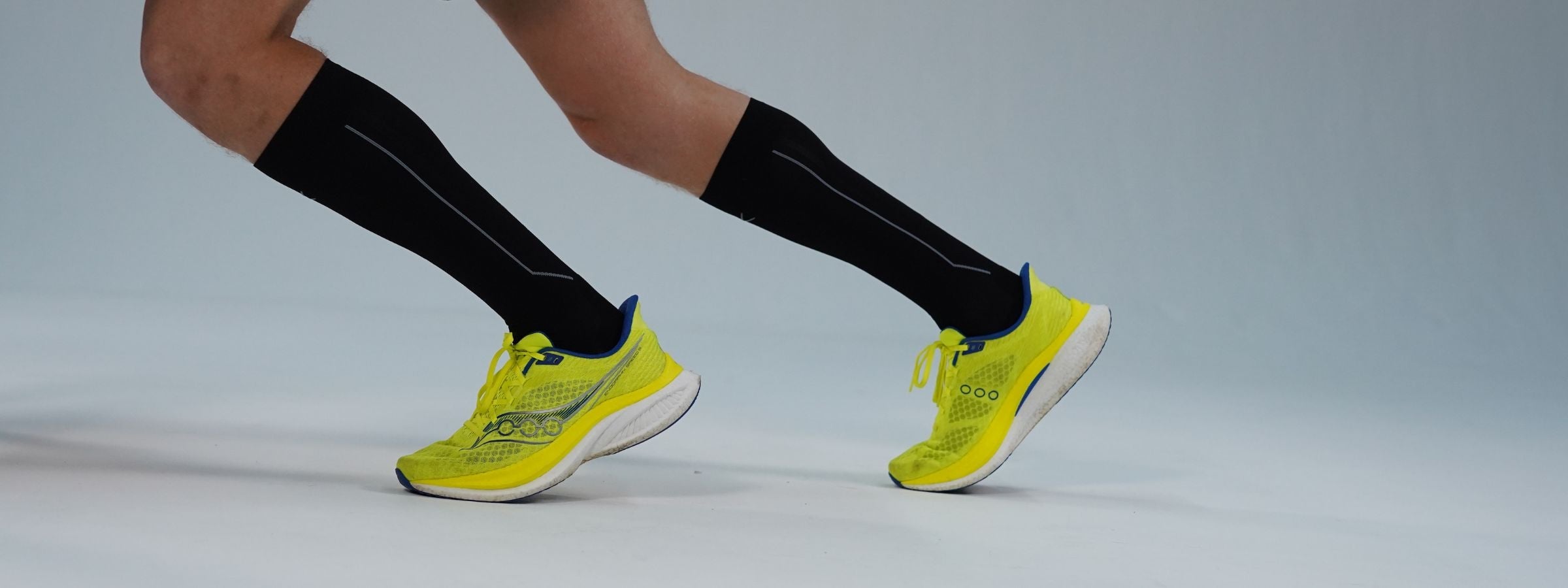
Do compression socks really make you faster? What the science says
It's a persistent idea: put on compression socks and you run faster. Many athletes buy them with that expectation. But is it true? In this article, you'll find the honest answer based on the best recent research, plus what compression *can* do for you. Not a fairy tale, but an honest story.
The short answer
No, not demonstrably. For the average athlete, there is no evidence that compression during exercise leads to faster times, higher power, or longer endurance. Maarten, co-founder of KINEX, states unequivocally: "No, I don't put on compression socks and suddenly run a personal best because of them. It doesn't work that way. Speed still comes from training, good recovery, smart planning, and daring to push through on race day."
What the research shows
The numbers are clear. An updated meta-analysis by Wang and colleagues (2025, Journal of Sport and Health Science), based on 51 studies and 899 participants, found no meaningful difference in running time. Specifically for compression socks, Telles and colleagues (2025, Journal of Sport Rehabilitation) bundled 28 studies with 600 runners and found no difference in running speed, time to exhaustion, heart rate, lactate, or perceived exertion. Several large analyses, the same picture: no speed gain.
So where does the idea come from?
Partly from a real effect that is misinterpreted. Compression demonstrably reduces muscle vibrations, as Wang and colleagues (2025) also showed. That feels like stability and support, and it's tempting to think that less vibration automatically makes you faster. But that step has not been proven. Another part comes from people confusing recovery benefits with direct speed: you feel better the next day, and that colors your judgment of the sock.
What compression *can* do
The credible value lies in comfort and recovery. Fewer muscle vibrations, possibly less muscle soreness after exercise, and a supported feeling during long efforts. This can indirectly help: those who feel more comfortable and recover better can train more consistently, and consistency *does* make you better in the long run. Maarten keeps it honest: "Where I do find compression valuable is for the feeling during longer efforts and especially in my recovery afterward. That can indirectly help to train more consistently, but we shouldn't make a fairy tale out of it. The sock doesn't run the last five kilometers for you. You still have to dig deep for that part."
Conclusion
Compression socks are not a speed booster. Those who buy them to run a PR will be disappointed. Those who buy them for comfort, stability, and recovery support get their money's worth. The right expectation is not "I run faster," but "my legs are supported, and my recovery can benefit." Curious if compression makes sense during running itself? Read compression socks for running: sense or nonsense.
Persistence pays off.
Sources
Wang et al. (2025), Journal of Sport and Health Science · Telles et al. (2025), Journal of Sport Rehabilitation · da Silva et al. (2018), Sports Medicine · Brown et al. (2017), Sports Medicine · Engel et al. (2016), Sports Medicine