

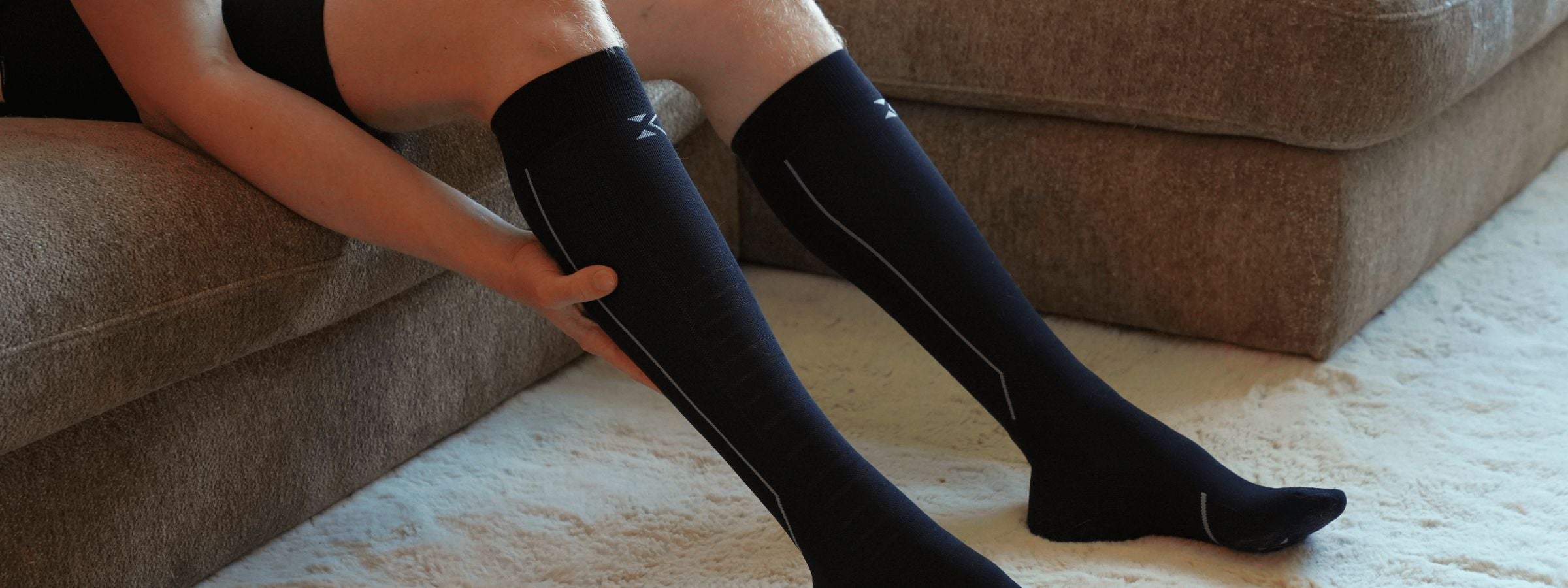
Do compression socks help with muscle soreness?
The short answer
Compression socks can likely reduce the perceived muscle soreness and stiffness after a strenuous workout, especially when worn during the recovery period. The average effect is small and not present in everyone. That compression prevents muscle damage, suppresses inflammation, or repairs muscle tissue faster has been much less convincingly demonstrated.
In short: it can make recovery feel more pleasant, but it's not a button you can press to turn off muscle soreness.
What is muscle soreness anyway?
Muscle soreness that only appears later is called DOMS, or Delayed Onset Muscle Soreness. Justin, physiotherapist and co-founder of KINEX, explains how it occurs: "Muscle soreness after a strenuous workout mainly arises because your muscles have undergone a load they are not yet fully accustomed to. This causes minor damage to the muscle tissue, and then the recovery process begins. This is especially seen after heavy strength training, downhill running, or a high-intensity competition."
The symptoms usually become noticeable only a few hours later, are strongest between 24 and 72 hours, and then subside. It is not the same as lactic acid, which is processed much faster. And more pain does not automatically mean more damage or a better workout. Muscle soreness is primarily a feeling, not a reliable measure of your recovery.
What does research say about compression and muscle soreness?
The picture is mixed, but not negative. Older meta-analyses were positive: Hill et al. (2014) found an average effect on muscle soreness. A large review of compression garments (Leabeater et al., 2022) found that out of 26 recovery studies, 20 reported less muscle soreness. Reduction of perceived muscle soreness is thus one of the more consistent effects in the literature.
At the same time, there are robust null findings. Heiss et al. (2018) applied 60 hours of compression to one leg and not to the other and found no difference in muscle soreness, swelling, or swelling on MRI. Hotfiel et al. (2021) also found no convincing difference with a knee-high sock. And a meta-analysis specifically looking at compression socks during running found no reduction in lower leg muscle soreness (Telles et al., 2025).
The honest summary: it is plausible that compression somewhat alleviates the perception of muscle soreness, but not strong enough to say that it prevents DOMS or accelerates biological recovery.
During or after exercise?
The purpose varies by moment. Justin: "During exercise, compression can support the lower leg and limit the feeling of muscle vibrations and fatigue. This can make a workout feel more comfortable, but it does not mean you won't get any muscle soreness. After exercise, it's more about recovery comfort. Compression can then help against a heavy, stiff, or swollen feeling."
The evidence is clearest for wearing during recovery. This aligns with how Maarten, co-founder of KINEX, uses it: "Especially after long runs and competitions, I have noticed a difference. My muscle soreness doesn't completely disappear, but my lower legs feel less stiff and heavy if I wear compression socks afterward. After a long run, I prefer to put them on relatively quickly and wear them for a few more hours."
For him, it's a fixed part of his routine: "In combination with good food, drink, gentle movement, and sleep, my recovery feels more complete."
More pressure or longer wear is not better
A persistent idea is that stronger compression or longer wear automatically yields more benefits. That's not true. Studies with different pressures and wearing times do not show a simple "the more, the better" pattern. Justin: "The most important thing is that the sock fits well and remains comfortable. More pressure or longer wear is not automatically better."
A practical and defensible starting point: put on the socks relatively quickly after a strenuous workout if they fit comfortably, and wear them for a few hours or during the first recovery evening. Not because this is proven to be optimal, but because it aligns with how most positive studies are designed. You can read more about wearing duration in how long and how often to wear compression socks.
How does it compare to other recovery methods?
Massage, among non-medical methods, has one of the more consistent effects on perceived muscle soreness, similar to or slightly stronger than compression. Cold and ice baths can reduce pain in the first 24 hours but are less suitable as a regular routine after every strength training session. Sleep is not an acute treatment, but it is a basic prerequisite: too little sleep actually makes pain feel stronger.
The most reproducible effect of compression is perceptual: it feels more pleasant, supported, and less stiff. That doesn't make it worthless, but it's different from demonstrably faster tissue recovery.
When muscle soreness is a signal
Justin: "Normal muscle soreness usually comes on gradually, often later in the day or the next morning. The muscle feels stiff and tender, but you can usually still move normally. After a few days, it should clearly subside."
Be careful with sharp or sudden pain during exercise, significant swelling, bruising, clear loss of strength, or limping. And with extremely strenuous exertion, dark urine is a serious warning sign. Justin: "Then you should seek medical help. When in doubt, it's better to have an injury checked than to suppress the pain and continue training."
What compression does and doesn't do
Plausible: compression during recovery can modestly reduce perceived muscle soreness and stiffness, and some athletes experience more comfort and support.
Not convincingly proven: that compression prevents DOMS, accelerates the removal of waste products, suppresses inflammation, speeds up muscle recovery, or that more pressure provides more pain reduction.
The conclusion
Compression socks do not make muscle soreness disappear. The fairest conclusion is that for some athletes, they can alleviate the perception of muscle soreness and stiffness, especially as a recovery aid after a strenuous workout. The evidence for faster biological recovery remains limited. See it as a comfortable addition to sleep, nutrition, and sensible training progression, not as a substitute. Are you training for a long distance? Also read muscle recovery after a marathon or long endurance training.
Perseverance wins. Good recovery helps you keep going.
Medical disclaimer
This article provides general information and is not personal medical advice. In case of sharp pain, significant swelling, loss of strength, or dark urine after exercise, a medical evaluation should take place.
Sources
Hotfiel et al. (2018), DOMS pathophysiology · Hill et al. (2014), British Journal of Sports Medicine · Brown et al. (2017), Sports Medicine · Dupuy et al. (2018), Frontiers in Physiology · Leabeater et al. (2022), Textiles · Weakley et al. (2022), Sports Medicine · Heiss et al. (2018) · Hotfiel et al. (2021) · Négyesi et al. (2022), Sports Medicine · Telles et al. (2025), Journal of Sport Rehabilitation · Davis et al. (2020) · Palsson et al. (2023), Sleep Medicine