
Difference between Class 1 and Class 2 compression stockings
What are the classes?
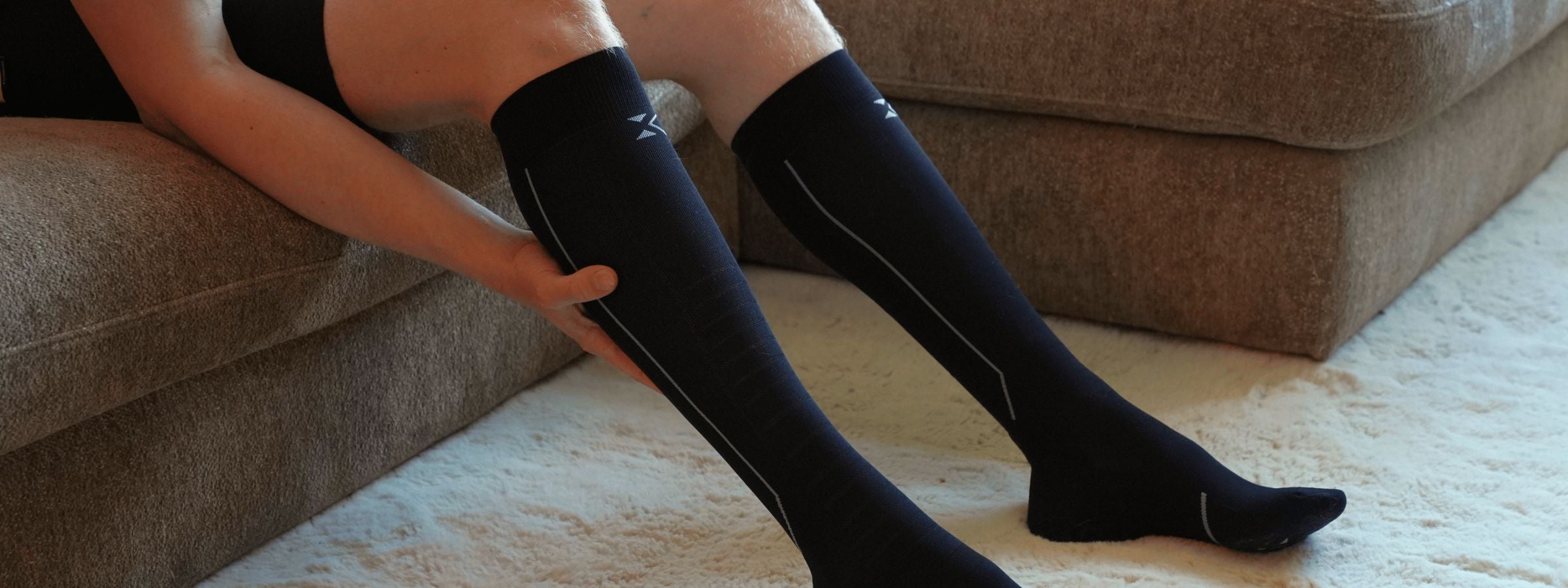
Compression classes indicate how much pressure a sock exerts, measured at the ankle. In the German RAL standard, a widely used European standard, these are the values:
- Class 1: 18-21 mmHg, light compression
- Class 2: 23-32 mmHg, moderate compression
- Class 3: 34-46 mmHg, strong compression
- Class 4: 49 mmHg and higher, very strong compression
Please note: you sometimes see Class 1 listed as 15-21 mmHg. This is because different countries use different limits. The British, French, and American systems differ from the German RAL standard. Therefore, the term "Class 1" or "Class 2" means little without the corresponding mmHg value and the standard on which it is based. Still not sure what mmHg means? Then first read gradual compression explained.
When Class 1 and when Class 2?
Justin, physiotherapist and co-founder of KINEX, uses a clear rule of thumb: "Class 1 provides milder pressure and is often suitable for daily use, an initial introduction to compression, or slightly tired legs. Class 2 provides significantly more support and can be interesting for athletes who seek firm, noticeable compression during prolonged exertion or during their recovery."
Is Class 2 better than Class 1?
Here's the honest answer: for sports, it has not been proven that Class 2 performs better than Class 1.
Direct comparative studies in athletes are scarce, and the results are not conclusive. Research by Hill et al. (2017) found that higher pressure could improve recovery after heavy muscle exertion. But Mizuno et al. (2017) found that moderate pressure of around 15 mmHg protected some outcomes better than 30 mmHg during long-distance running. And a study by Li et al. (2025) found that moderate compression provided the most balanced response.
In other words: more pressure does not automatically mean more effect. The evidence does not support the simplistic reasoning "the firmer, the better."
When is Class 2 logical?
Class 2 has clear added value in specific situations, especially medical ones:
- Diagnosed venous edema (swelling)
- Chronic venous insufficiency
- Varicose vein complaints with clear swelling
- After certain venous procedures or thrombosis
- Prescribed by a doctor or vascular specialist
For these indications, Class 2 is clinically more relevant than light compression. But the fact that Class 2 is suitable for someone with edema does not automatically mean it is the best sports sock for a healthy runner. Medical symptom control and sports performance are different things.
When is Class 1 or lighter sufficient?
- Slightly tired or heavy legs
- Minor swelling without vascular disease
- Prolonged sitting or standing, and travel
- Healthy athletes who primarily use compression for comfort and support
- Those who tolerate higher pressure poorly
- Long-term daily use, where comfort is important for compliance
Research by Goetz et al. found that 18-21 mmHg was often experienced as more comfortable than 23-32 mmHg. A theoretically stronger pressure that you take off after an hour because it feels uncomfortable is practically less valuable than a pleasant pressure that you wear all day.
When is Class 2 too firm?
Justin is clear about this: "Compression should feel firm, but never painful or constricting. When someone experiences tingling, numbness, discoloration, cold feet, increasing pain, or clear pressure marks, something is wrong. Then you first look at the size and how the sock is worn. After that, a lower compression class may be more logical."
In cases of severe arterial disease, advanced diabetic nerve damage, severe heart failure, or severely reduced sensation in the legs, medical assessment is necessary before using compression. In doubt? Ask a doctor.
Why KINEX chooses Class 2
Maarten explains the reasoning: "KINEX consciously chooses Class 2 because we did not want to make an ordinary tight sports sock, but a product with clear and controlled gradual compression. Our target group consists of athletes who take their training and recovery seriously and are looking for firm support that they actually feel. We are not saying that harder is always better or that every athlete will run faster with Class 2. The scientific results for direct performance improvement are too varied for that. Our reasoning is that we want to offer reliable, technically controlled compression, rather than a sock that only feels tight and whose pressure is unknown."
There's another reason: stability. With the firmer compression, KINEX aims to provide more stability in the lower leg. And more stability theoretically means even less muscle vibration, and precisely that vibration reduction has been scientifically proven.
Still in doubt?
Justin's advice: "I would first ask what you want to use the sock for. If you mainly seek light comfort during work, travel, or daily use, Class 1 may be sufficient. If you want firmer sports compression for long training sessions, competitions, or recovery, Class 2 can be a good fit, provided you choose the correct size. For Class 2, perhaps start with a shorter wearing duration so you can experience how your legs react."
Besides the class, the length of the sock also plays a role in your choice. For that, read short vs long compression socks: which do you choose?
The conclusion
Class 2 is firmer than Class 1, but not necessarily better, especially not for sports. Which class you need depends on your goal. For medical conditions with swelling, Class 2 is often more logical. For comfort, light support, and daily use, Class 1 can be perfectly adequate. In case of a medical condition, are you in doubt? Ask for advice from a doctor or vascular specialist.
Sources
RAL-GZ 387 · Hill et al. (2017), International Journal of Sports Physiology and Performance · Mizuno et al. (2017), PLOS ONE · Li et al. (2025), Sensors · Wang et al. (2025), Journal of Sport and Health Science · De Maeseneer et al. (2022), European Journal of Vascular and Endovascular Surgery · Goetz et al. (2019), Clinical Hemorheology and Microcirculation · Rabe et al. (2020), Phlebology