

Article: Short vs. Long Compression Socks: Which to Choose?
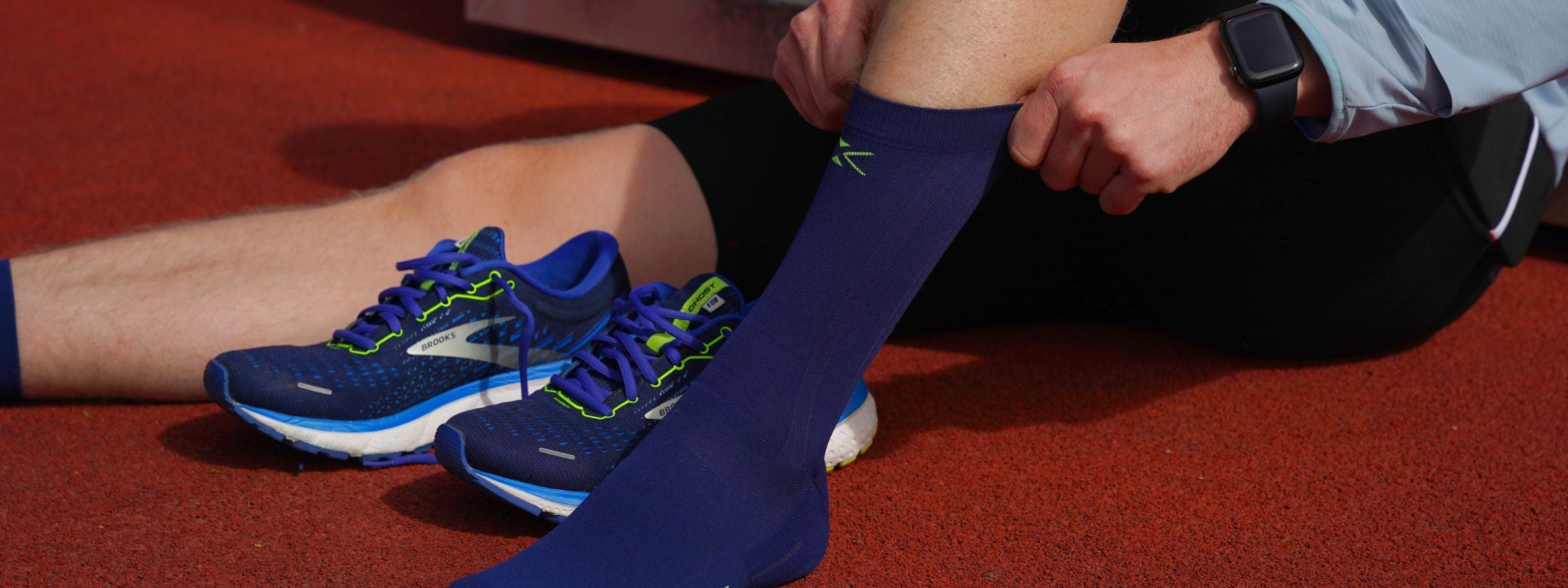
Short vs. Long Compression Socks: Which to Choose?
The core principle: compression works where the sock sits
The main rule is simple: a sock can only support the area it actually covers. A short sock works on your foot and ankle. A long sock also covers your calf and most of your lower leg.
That sounds obvious, but it's at the core of the entire choice. A short sock cannot have the same effect on your calf, simply because it doesn't enclose your calf. That doesn't make it worse, it makes it different.
What does the research say?
Honestly: there is hardly any direct research comparing short and long compression socks under the same conditions. The strongest study comes from Sun, Munro, and Zehr (2021), who compared ankle-high and calf-high compression in twelve participants. Both affected sensory and neuromuscular responses, but the calf-high sock provided the most widespread effects during walking and shortened recovery time after a balance perturbation.
This supports the idea that more coverage can lead to broader effects. But it doesn't prove that a long sock makes you run harder or recover faster.
When do you choose a long sock?
Maarten, co-founder of KINEX, makes a conscious choice: “I personally wear the long sock more often when running, especially during longer training sessions and competitions. Then I want my entire lower leg to be enclosed so I get the maximum effects of compression.”
Justin, physiotherapist and co-founder of KINEX, approaches the question from his knowledge of the body: “Where is someone seeking support? When complaints, fatigue, or stress are mainly around the calf and lower leg, a long compression sock is more obvious.”
A long sock is the logical choice if:
- Your calves feel tired or heavy during or after exercise
- You are looking for support for your calf muscles during long endurance efforts
- You suffer from swelling in your lower leg
- You want compression over the entire calf, for example during long running sessions
When is a short sock the better choice?
Maarten: “I'm quicker to grab the short sock for strength training, cycling, padel, or on warmer days. I also find it easy for daily use. So for me, the choice mainly depends on the duration of the effort and how much support I want to feel around my calf.”
A short compression sock is logical if:
- You are looking for targeted support around the foot and ankle
- You train indoors or in warm conditions and want less heat around the calf
- You want maximum freedom of movement without pressure on the calf
- You like to wear them discreetly under normal clothing, even outside of sports
The biggest misconception about short socks
Justin debunks a persistent misconception: “The biggest misconception is that a short compression sock is automatically a weakened version of a long sock. That's not true. A short sock simply works on a smaller area. What it cannot do is provide direct compression around the calf. If you are specifically looking for support for the calf and the entire lower leg, then a long sock is a better fit.”
Per sport
Running: if you have tired calves or are looking for lower leg support, the long sock is more logical. Want to know more? Read compression socks for running: useful or useless?
Cycling: cycling involves much less shock load than running, so the vibration argument weighs less. The choice here is mainly a matter of comfort and preference.
Strength training and indoor: a short sock can be pleasant due to less heat and more freedom of movement, unless you specifically want to support your calves.
Padel and intermittent sports: with many changes of direction, ankle compression can feel sensorily pleasant. Choose based on feel and comfort.
What to expect
Neither length is a guaranteed remedy for shin splints or calf cramps. For persistent complaints, a physiotherapist remains the right route, not just a sock.
Which class fits?
Do you want to know whether Class 1 or Class 2 is a better fit for you? Read the difference between Class 1 and Class 2.
The conclusion
A long sock is not universally better than a short one. It is more specifically suitable if your goal lies in your calf or lower leg. Don't choose based on "which is better?", but on "where do I want support?" Fit, comfort, and your goal outweigh length alone.
Sources
Sun, Munro & Zehr (2021), BMC Sports Science, Medicine and Rehabilitation · Wang et al. (2025), Journal of Sport and Health Science · Telles et al. (2025), Journal of Sport Rehabilitation · O'Riordan et al. (2023), Sports Medicine · Franke, Backx & Huisstede (2021), BMC Sports Science, Medicine and Rehabilitation · De Maeseneer et al. (2022), European Journal of Vascular and Endovascular Surgery