

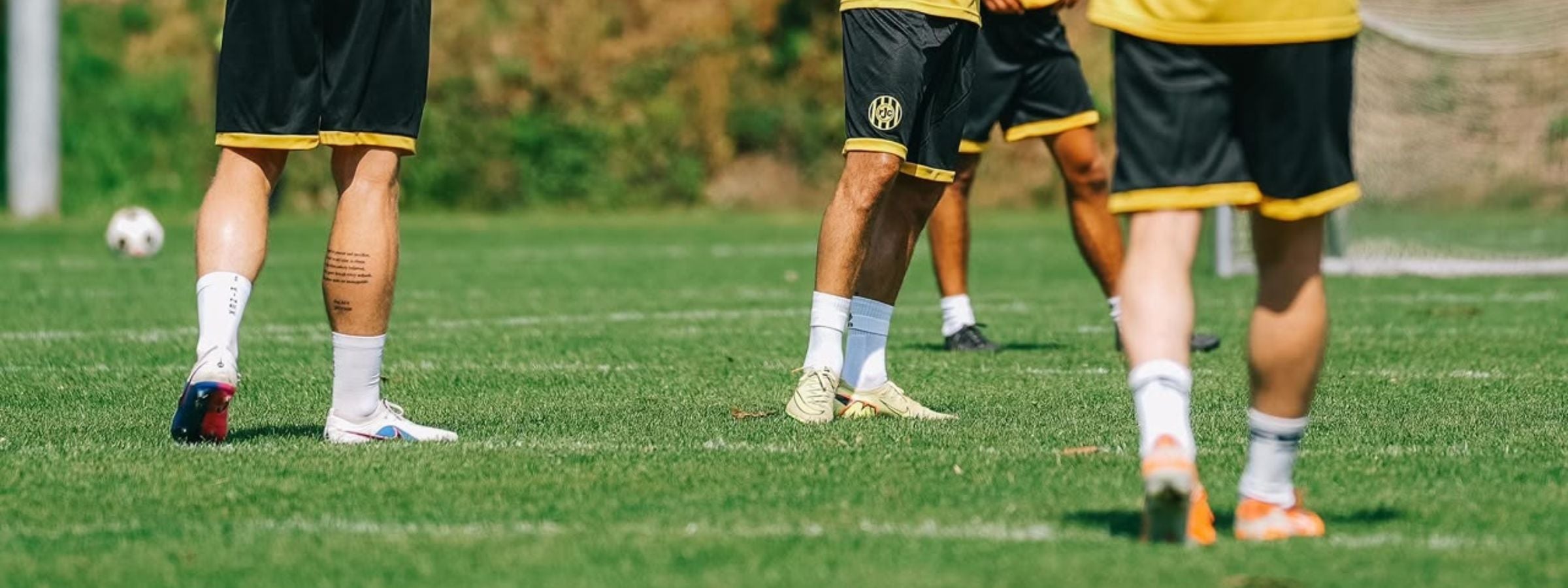
Compression socks for footballers and team sports
Football, field hockey, basketball: sports involving sprinting, cutting, stopping, and then going full speed again. Many players feel this stop-and-go strain primarily in their calves and lower legs, both during the game and especially the day after. Compression is often mentioned as a helpful tool, but the claims vary. This article provides an honest overview: what helps, and what doesn't.
The Strongest Effect: Recovery
Gimenes and colleagues (2021, Journal of Strength and Conditioning Research) had twenty under-20 footballers play two matches with 72 hours in between. The group wearing knee-high socks with 20 to 30 mmHg experienced less muscle soreness in the second match and covered more distance at high speed. Among basketball players, Atkins and colleagues (2020, Journal of Sports Sciences) found the same pattern: after a fatiguing protocol, the compression group reported significantly less fatigue and muscle soreness the next day. For an athlete with two matches in a weekend, this is relevant.
What Compression Doesn't Do on the Field
In those same studies, sprint, jump, and agility performance remained unchanged. So, compression does not demonstrably make you faster or more agile. Among female footballers, Pavin and colleagues (2019, Research in Sports Medicine) found that the general decline in physical condition after a match was not prevented. The benefit lies in how you feel and recover, not in a measurably better match performance. This aligns with Maarten's own experience as a footballer and co-founder of KINEX: "After a match with many sprints and cuts, I feel it mostly in my calves. That's why I primarily use compression after the match and on recovery days, but also during football training for stability."
Fit Matters More Than the Label
An important detail: fit likely matters more than the number on the packaging. Brown and colleagues (2022, Journal of Strength and Conditioning Research) found that among rugby players, only well-fitting, custom-sized compression clearly supported strength recovery within 48 hours; standard off-the-shelf garments were less convincing. This is precisely why a measured, well-fitting sock is more valuable than a randomly tight one. You can find out how to determine the correct size in our size guide.
No Evidence for Injury Prevention
What we emphatically do not claim is injury prevention. There are no convincing studies demonstrating that compression socks prevent calf injuries, Achilles complaints, or ankle sprains in team sports athletes. Some movement patterns change slightly in laboratory tests, but that is different from fewer injuries on the field. A sock is not an ankle brace and does not replace calf strength training or a good warm-up. Those prone to injuries should address the root cause.
Practical Advice for Team Athletes
The most logical application is for recovery: wear compression after a match or strenuous training, and on recovery days, especially with a busy match schedule involving two games within 72 hours. During play, it's about comfort and a sock that stays in place. Knee-high is a defensible choice, and fit outweighs the highest number on the packaging. Expect less muscle soreness and fresher legs, not extra sprint speed. If you want to understand why compression makes your legs feel less heavy after exertion, read what compression socks actually do.
Conclusion
Compression won't win games for you. But fresher legs on Sunday, after a tough Saturday, that's precisely where the difference lies. Use it as a recovery tool, not a performance promise.
Perseverance pays off. Even after the final whistle.
Sources
Gimenes et al. (2021), Journal of Strength and Conditioning Research · Atkins et al. (2020), Journal of Sports Sciences · Pavin et al. (2019), Research in Sports Medicine · Brown et al. (2022), Journal of Strength and Conditioning Research · Ghai et al. (2024), Annals of the New York Academy of Sciences · Weakley et al. (2022), Sports Medicine