

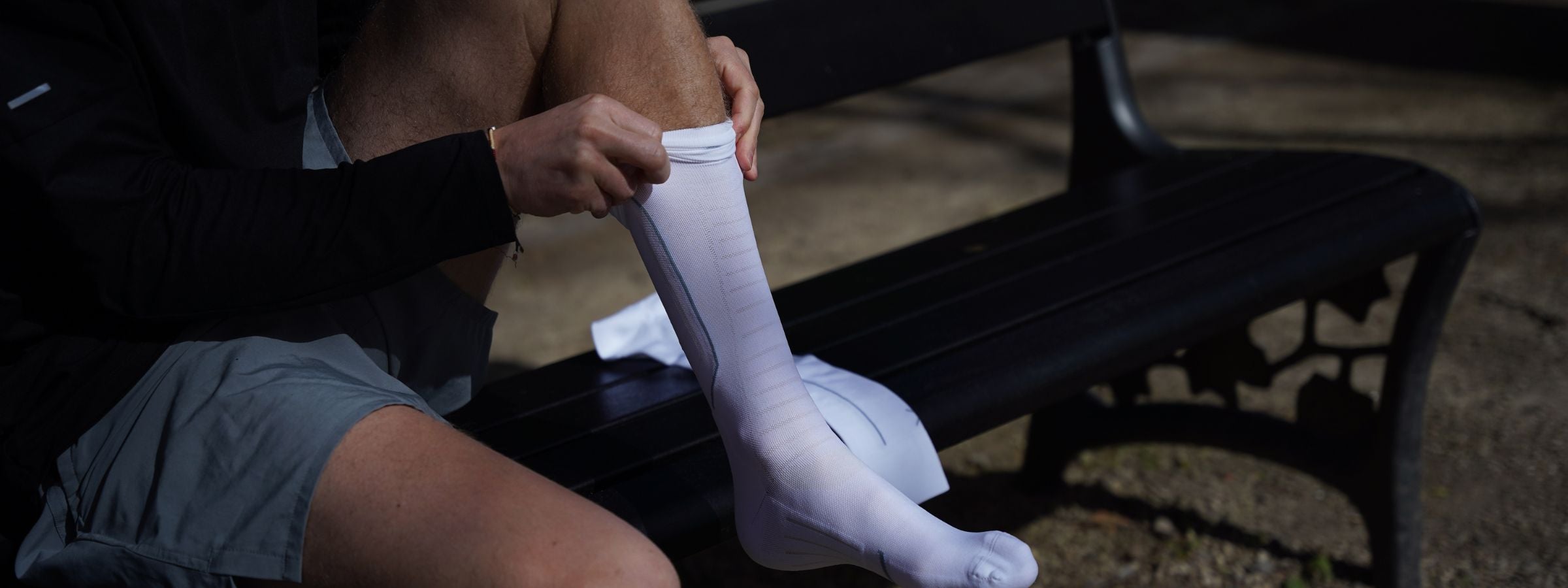
How does compression work on your body?
Compression socks squeeze your leg, and you feel it immediately. But what happens beneath the skin as a result? In this article, we explain in simple terms what graduated compression does to your veins, your calf muscle pump, and the vibrations in your legs. We honestly state what has been proven and what is primarily a plausible story, without sugarcoating it.
The Veins and the Calf Muscle Pump
Your veins must transport blood from your legs back upwards, against gravity. They receive help from your calf muscles. Justin, physiotherapist and co-founder of KINEX, explains it this way: “Every time you walk or contract your calf, that muscle acts like a pump. Graduated compression applies the most pressure around the ankle and gradually lessens towards the knee. This pressure supports the veins and helps the body with the return flow from the lower leg.”
What he explicitly adds: “The sock does not take over your body’s work. Your own movement and calf muscle pump remain important. Think of it as walking with a good team around you: you still have to put in the miles, but you receive support along the way.”
What Happens to Your Blood Flow
Compression narrows the veins slightly, increases the blood flow rate within them, and limits the accumulation of blood and fluid. A meta-analysis by O'Riordan and colleagues (2023, Sports Medicine) pooled 22 studies and found a small positive effect on blood flow in the legs, most clearly during exercise and in the recovery period, and less so at rest. A good example of the mechanism: Horiuchi and Stoner (2021, Vascular Medicine) showed that after three hours of sitting still, blood pooling in the lower leg increased by more than ten percent without compression, and by approximately four percent with compression.
An important nuance, because overclaiming helps no one: increased flow rate does not mean that every muscle automatically receives more oxygen. In some studies, the local blood flow to a specific muscle actually decreased slightly. The system as a whole works better, but it's not an oxygen turbo for your muscles.
The Effect on Muscle Vibrations
This is the most consistently demonstrated effect. With every foot strike, your soft tissue—your skin, fat, and muscles—vibrates briefly afterward. Compression holds that tissue more compactly together and dampens that vibration. The meta-analysis by Wang and colleagues (2025, Journal of Sport and Health Science), based on 51 studies, found a clear reduction in tissue vibration, and Broatch and colleagues (2020, Medicine & Science in Sports & Exercise) measured less tissue movement and even less electrical muscle activity during running.
And Lymph and Fluid?
Compression can also limit the accumulation of fluid in the tissue, especially during prolonged standing or sitting. This works by reducing the supply of new fluid and improving the drainage of existing fluid (Rabe and colleagues, 2018, Phlebology). What we do not do here is make the leap to detoxification or accelerated removal of waste products. Lactate, for example, is not a waste product that a sock squeezes out of your muscle, but a fuel that your body reuses. The evidence that compression removes lactic acid faster is contradictory and weak. We therefore disregard such a claim.
The Conclusion
The honest story about compression is mechanical and hemodynamic: controlled pressure supports venous return, limits the accumulation of blood and fluid, and dampens muscle vibrations. The magnitude of this effect depends on fit, pressure, and what you are doing. It is real support, not an engine that takes over the work. If you want to know exactly how this pressure distribution comes about, read graduated compression explained.
Perseverance pays off. Your body does the work, good compression helps.
Sources
O'Riordan et al. (2023), Sports Medicine · Horiuchi & Stoner (2021), Vascular Medicine · Wang et al. (2025), Journal of Sport and Health Science · Broatch et al. (2020), Medicine & Science in Sports & Exercise · Rabe et al. (2018), Phlebology