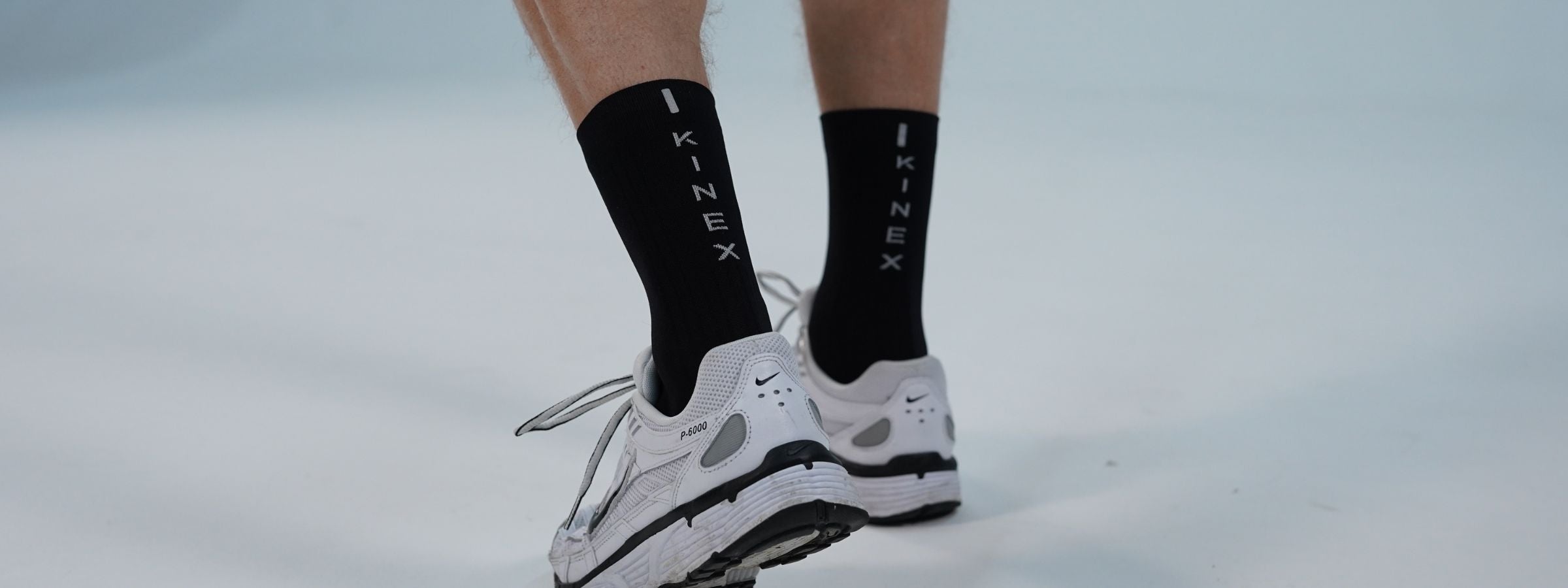


Shin splints: causes, recognition, and what compression can do
Shin splints are among the most common complaints of runners. A nagging pain along your shin that appears as soon as you put in miles. In this article, you will read exactly what shin splints are, how to recognize them, what the causes are, and what compression can and cannot do. An honest story, without empty promises.
What are shin splints?
Shin splints is the informal name for medial tibial stress syndrome, abbreviated MTSS. It is an overuse injury of the shin bone. The pain is located along the inner-back side of your tibia, often spread over an area of several centimeters.
Justin, physical therapist and co-founder of KINEX, explains how it usually starts: “It usually starts insidiously. A nagging, diffuse pain along the inner-back side of the shin. Initially, you feel it at the start of a workout and it subsides once you are warm. If it gets worse, it persists even after the workout.”
He immediately makes an important distinction: “If the pain is very sharp and at one small point, then I suspect a stress fracture and refer the person.” MTSS and a stress fracture are on a sliding scale of bone overuse. A diffuse, sensitive area indicates shin splints; a sharp point is a warning.
How common is it?
More common than you think. Shin splints are one of the most prevalent overuse injuries of the lower leg among runners and military personnel. In athletic and military groups, the incidence is around 35 percent. In one study of marine recruits, as many as 53 percent of female recruits developed shin splints during basic training.
What are the causes?
In practice, Justin almost always sees the same pattern: “Almost always too much, too soon. The volume or intensity increases too quickly, and the body doesn't get time to adapt.”
In addition, several other factors play a role: footwear, a collapsed arch, overpronation, hard or consistently the same surface, limited ankle mobility, and running technique. As Justin emphasizes: “It's rarely one thing. I always look at the complete picture of load and recovery.” This aligns with how you might also view tired, heavy legs: the total load matters.
Continue or rest?
The question every runner asks. Justin's answer is nuanced: “At the first signs, you don't have to stop immediately, but you do need to reduce the load and address the cause.”
The boundary is clear: “Pain that increases during running, persists afterwards, or changes your running pattern. In that case, continuing to train is unwise.” And he is honest about what recovery requires: “Rest and controlled progression are the foundation, and that simply takes time.” In research, runners with a structured running program took an average of about 105 days to fully resume training. So, patience is part of it.
What does research say about compression?
Here KINEX must be honest. Compression socks have not been proven effective as a treatment for shin splints. Authoritative medical reference works explicitly list compression stockings among treatments with no demonstrated effect, along with, among others, laser therapy and isolated stretching and strengthening exercises.
The most important study on this comes from the Netherlands. In 2012, Moen and colleagues first investigated the treatment of shin splints in non-military athletes. 74 athletes were divided into three groups: a progressive running schedule, the same schedule with calf stretching and strengthening exercises, and the same schedule with a sports compression stocking. The result: no significant difference between the groups in recovery time or satisfaction.
In other words: the compression stocking did not demonstrably speed up the recovery from shin splints. What does form the basis is relative rest and a controlled adjustment of your load.
What does help then?
The approach begins with the cause. Reduce your load and then gradually build up again. Critically review your training structure, footwear, surface, and technique. Prefab orthotics reduced the risk in marine recruits in research. For persistent complaints, sufficient calcium and vitamin D and adjusting your running technique can help. Of the additional treatments, shockwave therapy holds the most promise, although no single method is strongly enough substantiated to be presented as a certainty.
And where does compression fit in?
Justin is clear about its role: “Compression can provide a pleasant feeling for heavy legs during the build-up phase, but you shouldn't expect it to cure or prevent shin splints. The evidence for that simply isn't there.”
Maarten, an avid athlete and co-founder of KINEX, recognizes this from his own experience: “For me, it was on the inside of my ankles, extending up to my calves, especially when I resumed high mileage too quickly. What really helped was making my build-up more gradual and not pushing myself hard in every training session.” He is honest about compression: “It gave me a pleasant, supported feeling during the build-up, but it wasn't the solution. The solution was patience and smarter training.”
When to see a professional?
Justin: "If the pain persists or worsens despite rest and adjustments, if it shifts to a sharp point, or if you simply can't walk normally anymore. Then you want to rule out a stress fracture and have your load and technique specifically evaluated."
Conclusion
You don't solve shin splints with a sock. The core is to reduce your load, address the causes, and be patient during the build-up. Compression can give your legs a pleasant, supported feeling during that build-up, but it is not a treatment or a preventive measure. That's the honest story. If you doubt whether your symptoms are truly shin splints, have them assessed by a professional.
Perseverance pays off. Build up smartly, and give your legs the time they need.
Medical disclaimer
This article provides general information and is not personal medical advice. In cases of persistent, worsening, or sharply localized pain, a medical evaluation should take place to rule out, for example, a stress fracture.
Sources
Moen MH et al. (2012), Sports Medicine, Arthroscopy, Rehabilitation, Therapy & Technology · Moen MH et al. (2009), Sports Medicine · Moen MH et al. (2012), British Journal of Sports Medicine · StatPearls / NCBI Bookshelf (2025) · Galbraith & Lavallee (2009), Current Reviews in Musculoskeletal Medicine · Bhusari & Deshmukh (2023), Cureus